


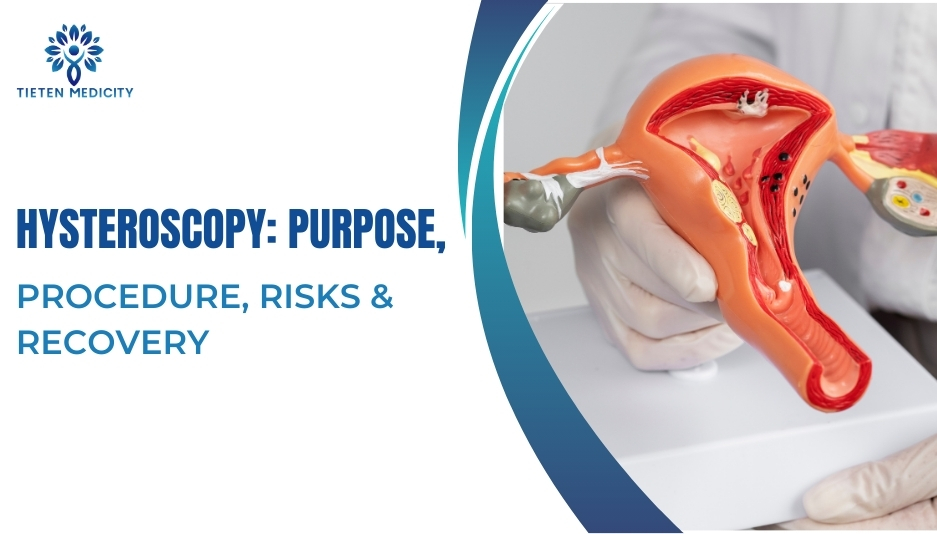
Hysteroscopy: Purpose, Procedure, Risks & Recovery
Hysteroscopy is a less invasive technique, by which the gynecologist checks the uterine interior with the help of a tiny lighted device called a hysteroscope. Usually, it is advised to women having abnormal uterine bleeding, infertility, repeated miscarriages, or suspecting uterine problems such as fibroids, polyps, or adhesions. Incorporating advanced diagnostic and surgical instruments, hysteroscopy becomes an exact, safe, and efficient method to locate and eliminate uterine disorders resulting in no major surgery. Hospitals like Tieten Medicity are well equipped with modern facilities along with specialist gynecologists in Thane performing hysteroscopy to guarantee safe results and speedy recovery.
Purpose of Hysteroscopy
It could be possible that your doctor would suggest undergoing a hysteroscopy in order to:
Firstly, the examination of abnormal or heavy menstrual bleeding.
Secondly, determining the reasons for infertility or recurrent pregnancy loss.
Thirdly, the elimination of fibroids, polyps, or adhesions that are present in the uterus.
Fourthly, the finding and removal of a misplaced IUD.
Fifthly, the performance of endometrial biopsy when cancer is suspected.
How the Hysteroscopy Procedure Works
Usually, a Hysteroscopy is done in an outpatient clinic and it doesn’t require a long stay in the hospital.
Step-by-Step Process
Depending on the kind of operation, the patient might be given either a local or a general anesthetic.
The scope is carefully moved through the vagina, cervix, and into the uterus. No external cut is made.
In order to get a better view, saline is used to stretch the uterus.
The doctor looks at the lining of the uterus, and if there are any abnormal growths, the doctor can remove them and also take a biopsy.
The time of the process varies from 15 to 45 minutes depending on how complicated it is.
Potential Risks & Complications
Hysteroscopy is usually a safe procedure; however, it is still accompanied by a risk, which is a possibility of the following:
Somewhat of a cramping and bleeding after the operation.
Infections, though very rare.
Unfavorable reaction to anesthesia.
Damage to the uterine wall (extremely rare).
Imbalance of body fluids during long surgical operations
Recovery After Hysteroscopy
The postoperative period is usually rather short, and consequently most ladies are able to go back home on the same day.
What to Expect During Recovery
- Mild cramps and spotting for 1–2 days
- Tiredness or dizziness if sedation was used
- Avoid intercourse, tampons, or swimming for a few days
- Resume normal activities in 24–48 hours (if advised)
When to Call Your Doctor
Seek medical help if you experience:
- Heavy bleeding
- Fever and chills
- Severe abdominal pain
- Foul-smelling discharge
Conclusion
Hysteroscopy is a very remarkable diagnostic and treatment method that not only gives the tissues of the uterus great visualization but also causes very little discomfort and comes along with fast recovery compared to conventional surgery. It is considered as an important procedure in the treatment of infertility, abnormal bleeding, and structural problems of the uterus. The Tieten Medicity Hospital, which boasts of expert gynecologists and modern surgical care, guarantees safe procedures and positive clinical outcomes. If you have abnormal symptoms or difficulty conceiving, hysteroscopy is likely to be a necessary step towards the correct diagnosis and better reproductive health.
FAQs
- Is hysteroscopy painful?
Most people feel mild cramping. It’s usually uncomfortable, not painful. Anesthesia may be used for operative procedures.
- How to prepare for a diagnostic hysteroscopy?
Eat normally, take a pain reliever if advised, avoid intercourse/tampons for 24 hours, and wear comfortable clothing.
- What is the recovery time?
Most return to normal activities within a day. Mild cramping or spotting can last 1–2 days.
- How long does a hysteroscopy take?
A diagnostic hysteroscopy usually takes between 5 and 30 minutes, while an operative one can take up to an hour.
- What is the purpose of a hysteroscopy?
To examine the inside of the uterus and diagnose or treat issues like abnormal bleeding, fibroids, or polyps.

